
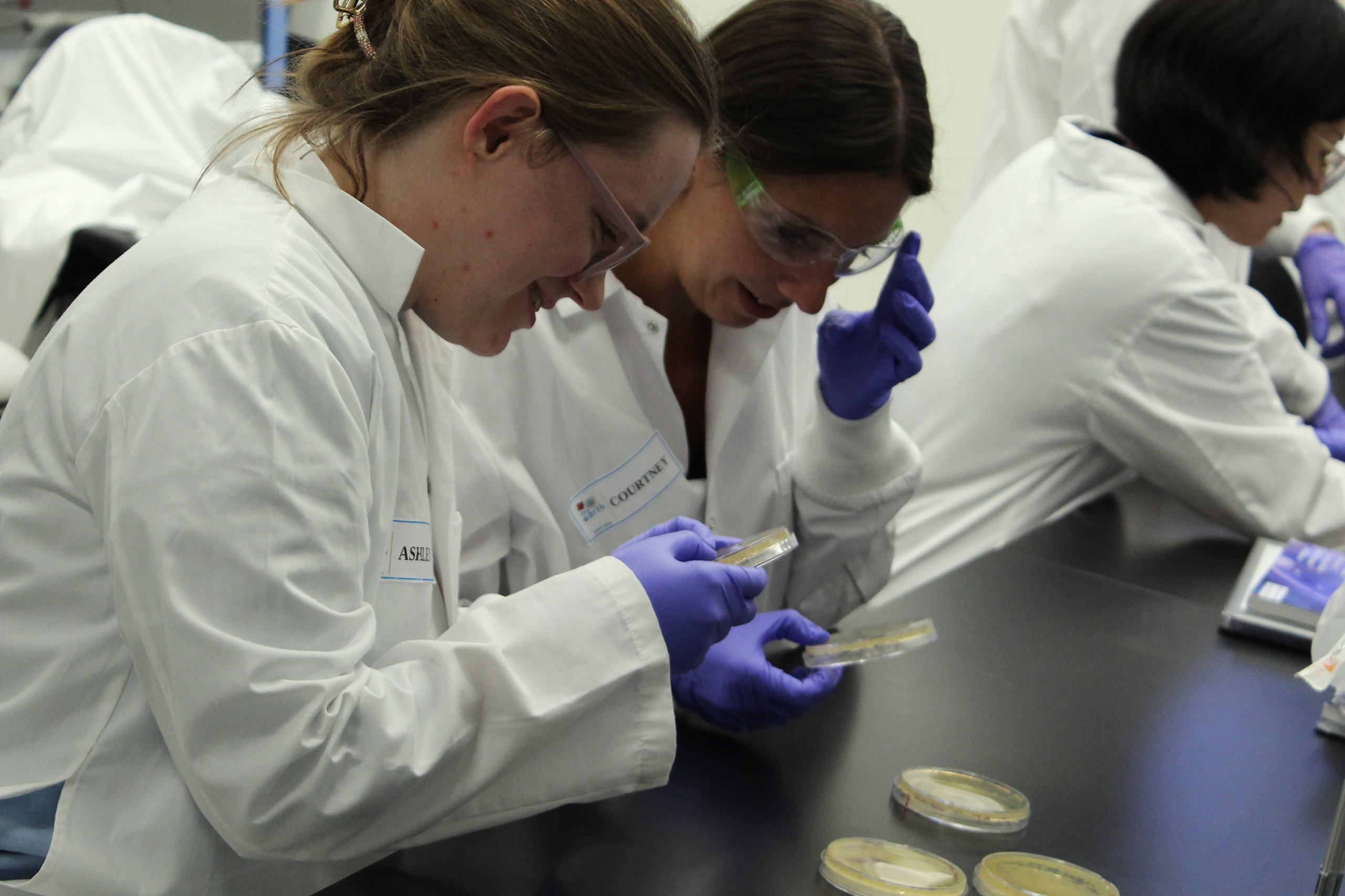
In a mile-marker year, Tiny Earth celebrates another international training! This past July, at Carleton University in Ottawa, Canada, 20 new Tiny Earth Partner Instructors (TEPIs) were trained to teach the Tiny Earth course.
Other international trainings have been hosted in Spain and India, and this increase in training locations highlights the remarkable efforts of TEPIs all over the world.
US TEPI trainings have been held in person at the University of Wisconsin–Madison, Johns Hopkins University, and the University of Connecticut, along with virtual training options since the COVID-19 pandemic. As Tiny Earth works to increase reach and access internationally for both instructors and students, the training programs continue to expand as well.
Canadian TEPIs Laura Pickell and Anil Gollapudi hosted their second training in July 2026. Hear about their motivations and strategies for hosting a successful event below.
Successful Trainings Start With Enthusiasm
Laura and Anil began building the knowledge and skills to develop a training program at Carleton University long before the initial training occurred. They joined the Tiny Earth network after completing an in-person training held at Johns Hopkins University in 2022. Over the next two years, Laura and Anil earned their certifications as TEPI trainers, an accomplishment that gives them the opportunity to host their own trainings.
By supporting all of these trainings, Laura and Anil earned their certifications as TEPI trainers, an accomplishment that gives them the opportunity to host their own trainings.
The facilitation side of trainings is very different from the participant side, and, therefore, Laura and Anil gained a unique perspective that would help them host their own trainings down the road. They learned strategies on how to run a training successfully and which areas they would likely need to make changes to adapt to Canada-specific priorities and logistical requirements.
At the pilot training that Carleton University hosted in the summer of 2025, Laura and Anil supported 10 participants. Once that first successful training wrapped up, they were eager to host a second and find the funding necessary to support more participants.
Laura and Anil secured a sponsorship from MiniOne Systems and an NSERC PromoScience grant, for training materials and equipment, and travel and lodging support for instructors from across Canada. Due to this funding, they were able to expand the next training to welcome 20 participants.
“It was very rewarding for me personally,” says Laura about being able to engage more participants. “What drives me is the impact this is going to have on students as well as on how instructors are going to be teaching.”
Bring Tiny Earth Trainings to Your Institution or Region
Facilitation of TEPI trainings is an opportunity for TEPIs to deepen their understanding of Tiny Earth. The process offers excellent professional development in mentoring, leadership, and facilitation. Often, facilitators are compensated financially, depending on available funding.
For TEPIs starting to think about what it would take to host their own training, the first step is to apply to become a certified TEPI trainer by filling out this form: Application to Become a Certified TEPI Trainer. After applications are reviewed, invitations are extended to help host a TEPI Training.
To be certified, a TEPI must help host two trainings (one in-person) as a facilitator. Facilitators present the lab sessions, organize interactive scientific teaching sessions, and facilitate a content working group. During the training, facilitators also help host event logistics and answer participants’ questions. After the training, facilitators serve as mentors as the newly-certified TEPIs in their content working group teach Tiny Earth for the first time.
Once certified, TEPIs are eligible to begin a conversation with Tiny Earth leadership about what it would take to host an event. Tiny Earth Headquarters has resources to guide the process, including schedules, logistic considerations, budget guidance, access to the pool of facilitators, and more. (Note: facilitation opportunities vary based on the number and location of trainings held each year, which depends on funding.)
Carleton University as an Example
Look to Carleton University for inspiration about how TEPI trainings can be adapted to different institutions and countries. Carleton training hosts adapted the US programs to fit their needs by utilizing their facilitation experience and willingness to grow further in Tiny Earth.
Before the training programs started at Carleton University, Tiny Earth students enrolled in Laura and Anil’s Tiny Earth course-based undergraduate research experience (CURE). Laura and Anil enlisted the help of their former Tiny Earth students — who had already worked through the curriculum — to provide lab support. Students gained experience developing and executing an event, and participating instructors got to see the student perspective on the Tiny Earth course as they actively learned how to teach it.
Laura and Anil recommend that other TEPIs looking to build their own training consider who they want to attract to trainings and how they can make attending trainings possible for that group of people.
“For us, our target is Canadian educators,” Laura says. “They typically want to integrate Tiny Earth in a variety of contexts and levels. It highlights the adaptability of Tiny Earth.”
By narrowing down to a specific audience of potential participants, the Carleton training hosts were able to find funding that could support their trainings. Initially, they used resources from their university for the first training, offering the pilot program free of cost to the 10 participants.
“We were lucky to have enough institutional support to get it off the ground and to create enough evidence to prove it works to then be able to get external funding,” Laura says.
The Overwhelmingly Positive Results
Classrooms across the world benefit from an expansion of TEPI trainings through scientifically-backed teaching methods that engage students more thoughtfully in science spaces. However, it’s Tiny Earth’s focus on the antibiotic crisis that has the highest potential to benefit from expanding TEPI trainings.
“Involving as many people as we can can help us tackle this as a collective,” Anil says. “Creating local ecosystems where awareness is absolutely critical and creating these trainings where more people can help us with that aspect of creating awareness. Involving a diverse group of people will definitely help us tackle this with a new perspective.”
The impact of international TEPI training programs is hard to measure long term this early into their implementation. However, the Carleton training hosts have found their participants showed strong changes in teaching approaches and an increase to student benefit in classrooms.
“In the exit surveys, we’ve received very positive feedback that the training was worthwhile,” Laura says. “[Instructors] feel more confident about implementing evidence-based teaching strategies and the lab curriculum.”
Results of these two Carleton University training programs can be felt across Canada. With 30 new TEPIs trained in 2025 and 2026, 18 new Canadian institutions now have the knowledge, resources, and support to implement a Tiny Earth course.
“This year we were very lucky to have such a close-knit group,” Laura says. “Nobody knew each other coming in, but by the end everybody had made friends and had really networked. It felt like we were building this really great support network.”
More resources, more focus on inclusive learning, and more instructors connected to each other means that students receive more benefits from their interactions with Tiny Earth curriculum. As Tiny Earth expands, developing more international trainings is crucial to student learning and overall global health.
Laura says, “Students are building their science identities and sense of belonging in science — feeling like they are scientists in addressing antimicrobial resistance.”

Tiny Earth Communications and Media Intern
Abigail is a journalism student at the University of Wisconsin-Madison with a focus on feature storytelling and digital media content. She has written for campus media during all three years of her time at UW-Madison and has built skills in storytelling, content strategy, and audience engagement. At Tiny Earth, she works to distill information into accurate and accessible narratives to support science communication and network knowledge.